
Making Something From Nothing: Cait Fitzpatrick of BWB On How To Go From Idea To Launch
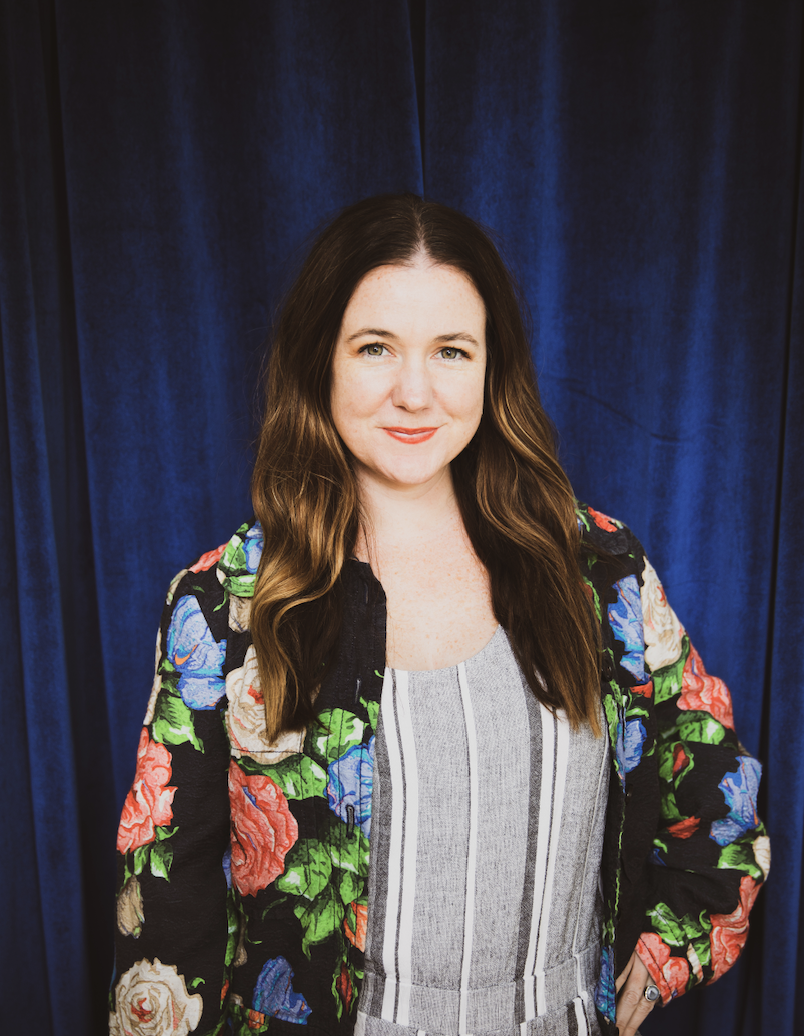
Cait has long brown, wavy hair and is standing in front of a blue velvet curtain, wearing a flowered, bright jacket and a gray/white stripped jumper
This article was originally posted on Medium’s Authority Magazine online publication.
As a part of our series called “Making Something From Nothing”, we had the pleaMedium’s Authority Magazinesure of interviewing Cait Fitzpatrick (she/her).
Cait believes that “business as usual” is old news; she is committed to revolutionary growth, and helping clients see the possibility and potential of their business ideas. She combines her love of writing, creativity, and improv to her life and work, and is endlessly curious. After spending too many winters in too many cold places, she has decided to chase the sunshine and works remotely as often as possible. Cait grew up on the Southside of Chicago and now resides in Norwalk, CT, a coastal town outside of New York City.
Thank you so much for doing this with us! Before we dive in, our readers would love to learn a bit more about you. Can you tell us a bit about your “childhood backstory”?
I had a very happy childhood where I was encouraged to always be curious and creative. From a young age, I was really talkative and social, and always wanted to help people. My mom was an early education teacher, and this fostered my creativity immensely. I remember going on family road trips, where my mom would create workbooks for us to track our journey on a map, or cross out the names of the states of the license plates on the road. I loved being on long roadtrips because she created this experience of surprise and enjoyment.
I also remember riding my bike to the library every week and taking my younger brother there once I was old enough, and can pinpoint my love of reading to those experiences.
I always felt challenged and was always learning new things. In the early stages of my career, I combined my curious nature and love of community building into market research and business development roles at a global communications agency which led me to where I am today.
Can you please give us your favorite “Life Lesson Quote”? Can you share how that was relevant to you in your life?
“Surround yourself with people who inspire you to become even better” is a quote or theme that has always resonated with me. I believe in partnership and collaboration, which is one of the many reasons I chose business partnership with my partner, Casey Carroll. I love working alongside Casey because we inspire each other and learn from each other every day. I also believe that being in business partnership is a key to our success, and a route that many folks can consider for their own success. More on that later!
Is there a particular book, podcast, or film that made a significant impact on you? Can you share a story or explain why it resonated with you so much?
I loved the book The $100 Startup, by Chris Guillebeau which simplified how to start and launch a business. For me, this book allowed me to find the approachability in something that can seem daunting and complicated. I have always believed in the entrepreneurial spirit, and this book came across as really optimistic and allowed me to see endless possibilities — both values and attitudes I believe in and admire deeply.
Ok super. Let’s now shift to the main part of our discussion. There is no shortage of good ideas out there. Many people have good ideas all the time. But people seem to struggle in taking a good idea and translating it into an actual business. Can you share a few ideas from your experience about how to overcome this challenge?
Creating, launching, and building a business takes an incredible amount of dedication.
The most important step is to decide how much time, energy, or resources one has, or wants to make, in realizing the business idea. For example, if someone has the resources, but does not have the time, certain business functions can be hired out. Or, if someone has the energy and the time, but no resource, they can consider fundraising, getting a loan, or mapping out a financial plan that will allow them to grow over time. If someone has the time and resources, but no energy, maybe a different or more values-aligned business is available to them instead.
Being realistic about what we can accomplish — on our own or with partners — is another area for consideration. Is there someone, a group of people, or even a complementary business (or businesses) that can be partnered with? We have a number of clients who have done this with one another to intentionally grow together. For me and Casey, working together on projects for many months with really successful outcomes led us to the decision to partner. We respect one another, had similar visions and dreams for growth, and worked together really well.
We both identified that we were ready to step into entrepreneurship, and had a strong self awareness about it. We help our clients do the same thing in identifying whether it is the right time for them, and whether they are ready to do what it takes to build their businesses.
The alignment between the idea and their commitment and momentum forward is absolutely critical.
Often when people think of a new idea, they dismiss it saying someone else must have thought of it before. How would you recommend that someone go about researching whether or not their idea has already been created?
Through our initial work and coaching, we help our clients develop confidence and clarity in their ideas so they can fully realize the potential, viability, and create something differentiated and ownable.
I think there is always a unique way to bring an idea to life, depending on what it is. We generally do simple Google searches and if the idea (or name!) appears available, we work with a trademark lawyer to do some additional research to double check.
For the benefit of our readers, can you outline the steps one has to go through, from when they think of the idea, until it finally lands in a customer’s hands? In particular, we’d love to hear about things like how to file a patent, how to source a good manufacturer, and how to find a retailer to distribute it.
BWB always recommends that our clients work with attorneys or use third-party service providers (e.g. LegalZoom) when they set up their businesses or contracts. Before we get to this point, our work helps clients determine their brand framework and revenue models, solidify their strategy, and the financial viability of their idea. However, the specific steps to launch their business really depend on what the idea becomes. For example, if there is no product associated, manufacturing and distributing won’t play a role.
What are your “5 Things I Wish Someone Told Me When I First Started Leading My Company” and why? (Please share a story or example for each.)
1 . The road is not linear, and pivoting as the world changes is key. Marti Konstant’s book “Activate Your Agile Career” is a great example of how responding to change can help us all grow.
2 . Strategy is incredibly important. Without the anchor, tactics don’t really work. It is often one of the most overlooked and least celebrated parts about building businesses, but truly the most essential. The sooner you have a strategy, the quicker you can grow! This is how we approach building any business.
3 . Balance the idea of being patient, while still paying attention to trends. We are always planting seeds for business growth, and sometimes true growth takes time. Observing the fluctuations on a month-to-month basis, or even year-to-year can be helpful, but needs to be taken with a grain of salt during the few couple of years of building and growth. It is important to keep this all in perspective.
4 . Inspiration comes from everywhere. All the time. Having a variety of outlets to have business-related discussions, problem solve, and gain input is worth its weight in gold. It simply can’t be taken for granted. Establishing an ongoing process for this, such as a coaching relationship or Mastermind program is a great way to bounce ideas off of each other, share leads, and have fun while doing it. Thank you to Maddy Osman, Ana Cvetkovic, and Jamie Haley for being part of my Monday Motivation crew.
5 . Having a “yes, and” mentality has helped us build a strong business. I love doing improv exercises to remind me of this. Impro by Keith Johnstone is one of my favorite books about this topic, and our journey to unlearning and reprogramming.
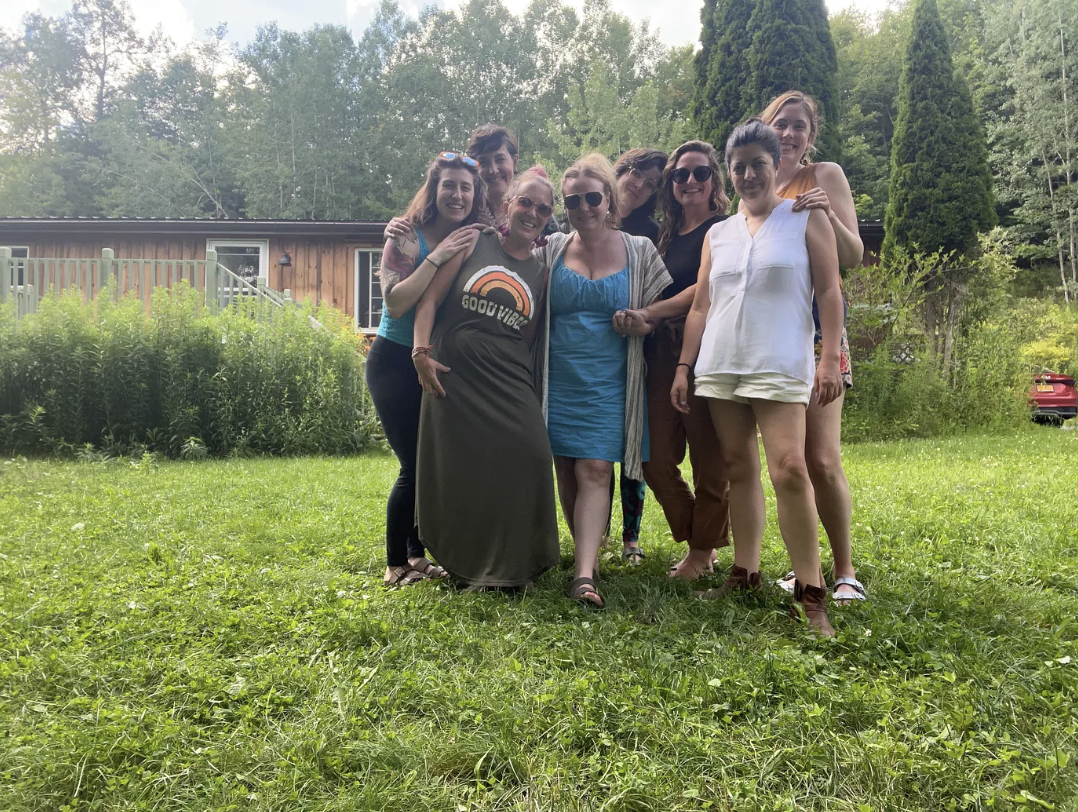
Clients gathered at a holistic branding retreat hosted by BWB, enjoying a spring day outside a garden-filled retreat house.
Let’s imagine that a reader reading this interview has an idea for a product that they would like to invent. What are the first few steps that you would recommend that they take?
We have a process that we call “Revolutionary Growth’’ which is our first step to launching a new idea. This is our cornerstone program, consisting of a series of workshops to unpack your ideas and create your intentional growth plan. This includes looking at the landscape and taking a critical look at your idea’s ideal images, words, and communications efforts.
At the end of this process, many folks decide not to proceed. For us, this is just as much of a success as someone who does move forward with realizing their ideas. In both cases, it allows our client to make a commitment one way or another. They are able to see how their vision could come to life and make change or impact in the world, and how they can sustain momentum forward.
There are many invention development consultants. Would you recommend that a person with a new idea hire such a consultant, or should they try to strike out on their own?
Our guiding mantra is: When One Of Us Rises, All Of Us Rise. We truly believe and abide by the idea that partnership, collaboration, and diversity of thinking is critical to the success of any business. BWB has become a living model of the power of partnership for many, and demonstrates that when we work together, and refuse to sacrifice our values or ourselves, even early-stage businesses and ideas can make a big impact and live the future we dream of now.
Beyond that, we have found that many of our solopreneur and small businesses clients are craving partnership in a variety of ways. Through our work, we offer coaching, consulting, and brand building support on an ongoing basis.
We’ve been doing a deep dive around partnership to further understand and break down how it impacts all of us and interviewing different partners on the BWB Questions to Hold podcast. To further bring the idea of partnership to the forefront, we recently launched a scholarship program called the partnerUP Project, offering one emerging entrepreneur the opportunity to go from idea to reality. Our first scholarship recipients are the Red for Revolution podcast team. Red for Revolution is a six-part audio drama centering intergenerational stories of Black women, queer love, and liberation which is an official selection to the prestigious Tribeca Film Festival.
What are your thoughts about bootstrapping vs looking for venture capital? What is the best way to decide if you should do either one?
I think this is different for everyone, depending on their situation. I would recommend speaking with a financial advisor or business coach to determine the best steps forward, and use tools like a revenue assessment to understand what the possibilities are for their individual business ideas. For example, identifying how much to charge for each product offering, and making realistic estimates around that.
Ok. We are nearly done. Here are our final questions. How have you used your success to make the world a better place?
Every client that we have helped launch or build their business.
To date, we have supported 190 clients, and are translating our approach into a proprietary curriculum and model that can be adopted on a bigger scale. The program includes practical tools to develop business frameworks and profitable and equitable revenue models. It also includes executive mentorship to build confidence and leadership skills to ensure women have the holistic support needed to successfully run their businesses and make an impact in the market.
We are so proud of the work we’ve created for others.
You are an inspiration to a great many people. If you could inspire a movement that would bring the most amount of good to the most amount of people, what would that be? You never know what your idea can trigger.
The idea of every business having a social impact fund, where funds are donated back to folks that need support or lack access. We have done this with our 3% fund and I see on our scale what a huge impact it can have. If every business did this, we would see a massive shift in how business is being done.
We are very blessed that some of the biggest names in Business, VC funding, Sports, and Entertainment read this column. Is there a person in the world, or in the US, with whom you would love to have a private breakfast or lunch, and why? He or she might just see this if we tag them.
adrienne maree brown
Thank you for these fantastic insights. We greatly appreciate the time you spent on this.
About the Interviewer: Douglas E. Noll, JD, MA was born nearly blind, crippled with club feet, partially deaf, and left-handed. He overcame all of these obstacles to become a successful civil trial lawyer. In 2000, he abandoned his law practice to become a peacemaker. His calling is to serve humanity, and he executes his calling at many levels. He is an award-winning author, teacher, and trainer. He is a highly experienced mediator. Doug’s work carries him from international work to helping people resolve deep interpersonal and ideological conflicts. Doug teaches his innovative de-escalation skill that calms any angry person in 90 seconds or less. With Laurel Kaufer, Doug founded Prison of Peace in 2009. The Prison of Peace project trains life and long terms incarcerated people to be powerful peacemakers and mediators. He has been deeply moved by inmates who have learned and applied deep, empathic listening skills, leadership skills, and problem-solving skills to reduce violence in their prison communities. Their dedication to learning, improving, and serving their communities motivates him to expand the principles of Prison of Peace so that every human wanting to learn the skills of peace may do so. Doug’s awards include California Lawyer Magazine Lawyer of the Year, Best Lawyers in America Lawyer of the Year, Purpose Prize Fellow, International Academy of Mediators Syd Leezak Award of Excellence, National Academy of Distinguished Neutrals Neutral of the Year. His four books have won a number of awards and commendations. Doug’s podcast, Listen With Leaders, is now accepting guests. Click on this link to learn more and apply.